You should undercook your chicken
Chicken cooked to the temperatures recommended by food safety agencies results in meat that is dry and tough.1 I’m not suggesting that you serve up chicken sashimi, but there is more nuance to cooking chicken than is common knowledge.
The official guidelines
Official guidelines provided by public health experts and institutions are simplified to minimize confusion and reduce potential risk. Providing a simple, easy-to-understand directive is a good thing, and from a public health perspective, minimizing the potential for illness or death is more important than having to eat dry chicken.
The specific recommendations provided by various public health institutions vary, so I’ve compiled a list of recommendations from four food safety agencies to get an overview of where they stand. Recommendations are ordered from most to least conservative.
- Health Canada recommends obliterating your chicken and cooking whole poultry to 82°C/180°F.
- Food Standards Australia New Zealand suggests cooking all poultry to 75°C/167°F.2
- The US Department of Agriculture (USDA) suggests cooking all poultry to 74°C/165°F.
- The UK Food Standards Agency recommends cooking all food to the time and temperature combination of 70°C/158°F held for 2 minutes. The agency also provides several other safe time and temperature combinations.
Understanding the guidelines
When publishing guidelines on cooking poultry, what food safety organizations are actually looking for is a 7-log reduction of Salmonella bacteria.3 Of the pathogens present in raw chicken, Salmonella is the hardest to reduce to safe quantities with heat, meaning that achieving a 7-log reduction in Salmonella in effect renders the chicken safe to eat.4
With the exception of the UK, official food safety guidelines give a single target temperature to meet to pasteurize chicken. These published temperatures are when a 7-nearly instantaneously (for chicken breast, this is at 72°C/162°F), plus a margin of error to protect against bad temperature readings.
However, achieving a 7-log reduction is a function of temperature and time. Pathogens start dying as low as 55°C/131°F, meaning that if you hold your chicken at that temperature for a long enough period of time, you could still render it safe to eat. This is worth exploring further, since chicken breast cooked above 70°C/158°F is unenjoyably dry and chalky.
How to undercook your chicken
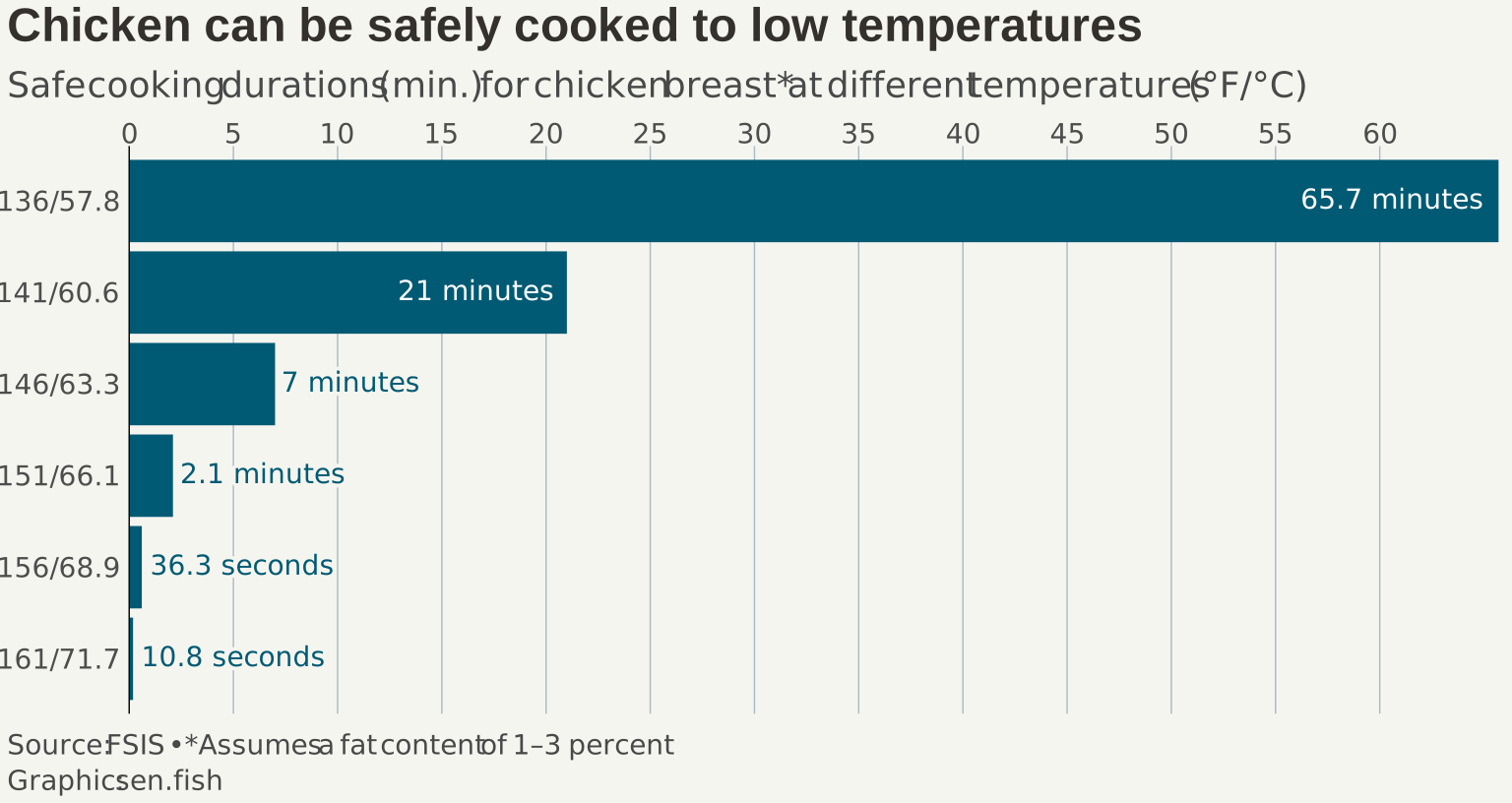
The exact time and temperature combination depends on what you’re cooking (and how you cook it). Thankfully for us, the Food Safety and Inspection Service (FSIS) of the USDA has published the “Salmonella Compliance Guidelines for Small and Very Small Meat and Poultry Establishments that Produce Ready-to-Eat (RTE) Products and Revised Appendix A” (what a mouthful!). In it, the FSIS provides safe time and temperature combinations for chicken at different fat contents (the presence of fat tends to increase the heat tolerance of pathogens). I’ve made a graph of the holding times for cooking chicken breast to different target temperatures.
Chicken can be safely cooked to low temperatures.
Safe cooking durations for chicken breast at different temperatures
Importantly (even though this often goes unmentioned), the FSIS time and temperature combinations are designed only for certain cooking methods and preclude cooking in most home ovens and other low-humidity/low-temperature cooking methods. For home cooks, you can follow the FSIS time and temperature guidelines only if you’re cooking in liquid (e.g. in a soup), cooking in a bag (i.e. sous vide), or using direct heat (grilling, pan-frying, broiling, or any other cooking method that rapidly cooks the exterior of the chicken).5
According to the FSIS guidelines, chicken breast (which has a fat content ranging between 1–3 percent) can be safely cooked if it is held at 66.1°C/151°F for just 2.1 minutes. Chicken cooked to a lower internal temperature like 60.6°C/141°F can also be safe to eat if held there for 21 minutes. You should also consider that in high-temperature cooking methods like pan-frying or grilling, the core temperature of the meat will continue to rise by an additional 6°C/10°F after you take it off the heat, meaning your meat may exceed your required holding temperature for much longer than you might expect.
A sidenote
The only way to reliably tell whether your chicken is cooked is to use a well-calibrated meat thermometer. Chicken that is cooked well past any edible temperature can still have pink meat and juices.6 Likewise, unsafe chicken can be firm, look opaque, and have clear juices. When using a temperature probe, you should try to hit the thickest part of the meat and insert the probe more than once to ensure you’re getting an accurate reading. Helen Rennie has a great video tutorial (4 minutes long) on using your thermometer correctly.
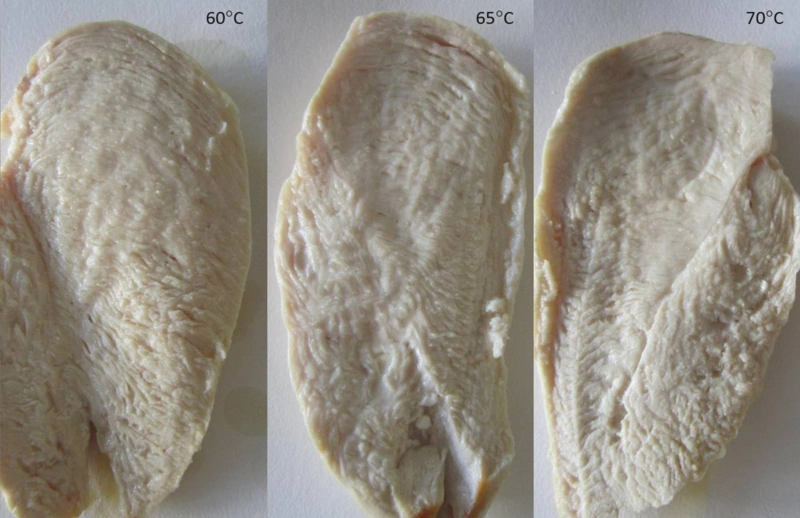
My personal preference for chicken breast is an internal doneness between 60.6°C/141°F and 63.3°C/146°F, where the chicken comes out opaque, but the meat remains soft and juicy and tastes fully cooked. To cook chicken breast to these temperatures, I use a wireless meat thermometer that my partner gifted me. It records the internal temperature of the meat throughout the cooking process and tracks the cumulative reduction of bacteria from the moment the meat hits 54°C/130°F.
Another option is to cook the chicken sous vide (in a bag submerged in hot water), which is popular among chefs. Kenji López-Alt has a helpful guide on getting started with sous vide cooking.7 Regardless of what cooking method you choose, carefully timing and checking the temperature of your chicken can net you much juicier chicken than you’d get by strictly following food safety organizations’ public-facing guidelines.
Footnotes
-
The advice in this post only applies to white meat (chicken breast). Dark meat tastes best when cooked to much higher temperatures (around 82°C/180°F–88°C/190°F) because it has lots of fat and connective tissue that can render out when cooking. ↩
-
Did you know Australia and New Zealand share standards agencies? I had no idea! ↩
-
Chicken has a 7-log-reduction standard because it has a high initial level of pathogens. Other meats, like beef or pork, have different (usually lower) log-reduction standards. ↩
-
For example, Campylobacter and E. coli are more heat sensitive than Salmonella and die sooner. ↩
-
Safely oven cooking chicken to these time and temperature combinations is not generally possible for home cooks since it requires either maintaining your oven at a relative humidity of at least 90% or cooking more than 10 pounds of chicken at once. See further details on pages 31–32 of the “FSIS Cooking Guideline for Meat and Poultry Products”. ↩
-
This is one of my biggest pet peeves. I hate when people complain that chicken is “undercooked” based on color alone. ↩
-
Thanks as well to Kenji for writing The Food Lab, where I first read about undercooking chicken. ↩
Comments